
The Robert C. Byrd Green Bank Telescope
Green Bank, West Virginia
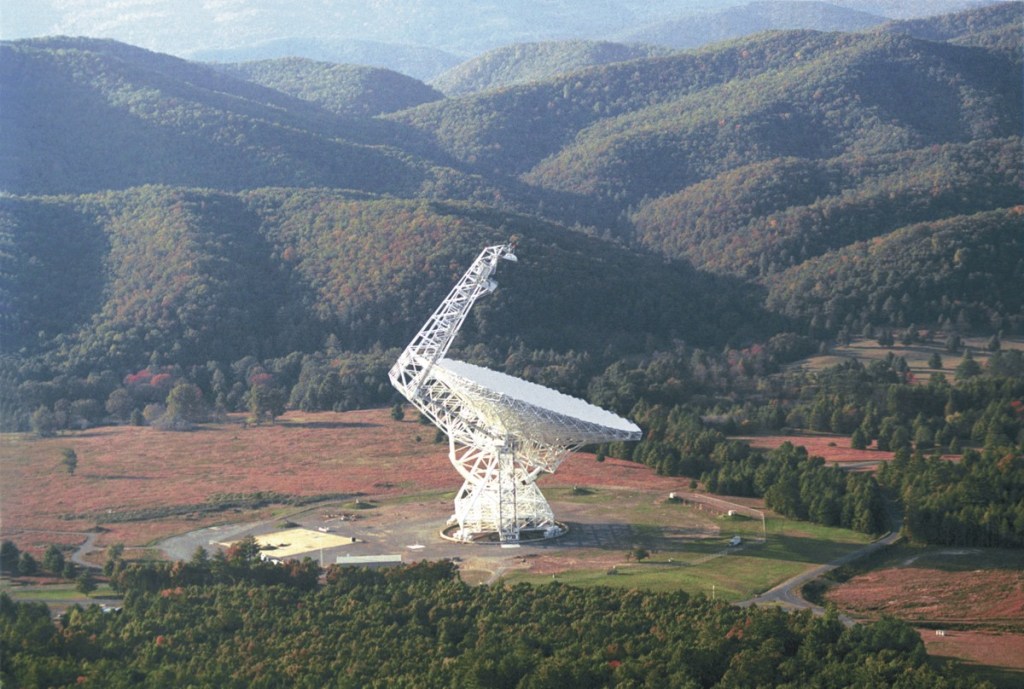
The Robert C. Byrd Green Bank Telescope (GBT) in Green Bank, West Virginia, US is the world’s largest fully steerable radio telescope. The Green Bank site was part of the National Radio Astronomy Observatory (NRAO) until September 30, 2016. Since October 1, 2016, the telescope has been operated by the newly separated Green Bank Observatory. The telescope honors the name of the late Senator Robert C. Byrd who represented West Virginia and who pushed the funding of the telescope through Congress.
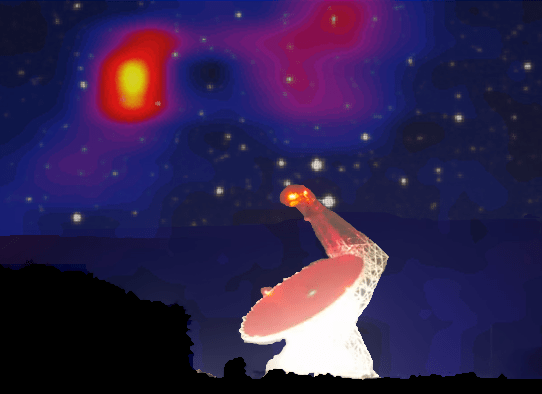
The Green Bank Telescope operates at meter to millimeter wavelengths. Its 100-meter diameter collecting area, unblocked aperture, and good surface accuracy provide superb sensitivity across the telescope’s full 0.1–116 GHz operating range. The GBT is fully steerable, and 85% of the entire local celestial hemisphere is accessible. It is used for astronomy about 6500 hours every year, with 2000–3000 hours per year going to high-frequency science. Part of the scientific strength of the GBT is its flexibility and ease of use, allowing for rapid response to new scientific ideas. It is scheduled dynamically to match project needs to the available weather. The GBT is also readily reconfigured with new and experimental hardware. The high-sensitivity mapping capability of the GBT makes it a necessary complement to the Atacama Large Millimeter Array, the Expanded Very Large Array, the Very Long Baseline Array, and other high-angular resolution interferometers. Facilities of the Green Bank Observatory are also used for other scientific research, for many programs in education and public outreach, and for training students and teachers.


 Travel Adventures
Wasn’t there another telescope before this one? What happened to It?
LikeLike
Yes there was one before this one. The previous telescope collapsed on 15 November 1988 due to the sudden loss of a gusset plate in the box girder assembly, which was a key component for the structural integrity of the telescope.
see: https://en.wikipedia.org/wiki/Green_Bank_Telescope and https://www.nrao.edu/whatisra/hist_300ft.shtml
LikeLike